
Many Saber Unbound players lose progression speed not because they play poorly, but because they spend too much time looking for the right opportunities. Searching without structure creates downtime, fatigue, and rushed decisions. This guide teaches you how to find what matters quickly: good fights, efficient routes, objective windows, and productive session conditions. All methods were verified in-game in June 2026.
Finding is a skill. It includes map reading, timing judgment, target selection, and fallback planning. When this skill improves, your entire account progress accelerates because every session contains more meaningful actions and fewer empty minutes.
Keep these companion pages available:
- Hub overview: All Guides
- Beginner setup: Beginner Guide
- Gameplay execution: How to Play
- Resource farming: How to Get
- Objective routing: How to Complete
Define What You Are Trying to Find
Before moving, define your target class for the next block:
- Resource opportunity.
- Training opportunity.
- Objective completion opportunity.
- Low-risk recovery opportunity.
If you do not define target class, every signal looks equally important and you drift. Drift is the main cause of search inefficiency.
Use this simple sentence before each block: “In the next ten minutes, I am finding X and ignoring non-overlapping distractions.”
The 3-Stage Finding Method
Use this method in every session:
- Scan: observe environment and current activity density quickly.
- Select: choose the highest-value available option for your target class.
- Commit: execute without constant re-evaluation for a short fixed window.
Most players fail at stage 3. They keep scanning while executing, which creates hesitation and lost momentum. Commit for a short period, then reassess.
Map and Lobby Awareness
Spatial awareness heavily influences finding speed. The lobby and connected routes determine where opportunities cluster and where dead movement occurs. Use map understanding to:
- Anticipate where activity is likely.
- Avoid low-yield detour zones.
- Move along routes that preserve exit options.
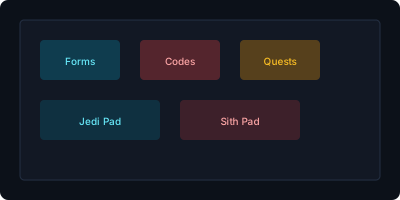
The layout diagram above should be treated as a routing reference, not just a visual. Repeatedly running efficient lines lowers your search time and improves session consistency.
Build a Fallback System
No scouting method is perfect. Sometimes your first target class is temporarily weak. Without a fallback system, you lose minutes deciding what to do next.
Create two fallback layers:
- Fallback A: same goal, lower reward but fast access.
- Fallback B: different goal that still provides progression value.
Example:
- Primary: high-value objective target.
- Fallback A: medium-value objective nearby.
- Fallback B: safe resource loop from How to Get.
This keeps momentum alive even in poor windows.
Finding Better Training Fights
If your objective is improvement, not only rewards, use scouting filters:
- Is this opponent type useful for my current training goal?
- Can I engage without heavy disruption to my route?
- Is my current state stable enough for meaningful learning?
Not every fight improves you. Choose engagements that match your specific focus, such as timing control or defensive resets. This improves learning quality per minute.
For execution structure once you engage, follow How to Play.
Reduce Search Noise
Search noise is information that feels urgent but has low value for your objective. Common noise types:
- Random target chasing unrelated to your plan.
- Constant route switching after minor setbacks.
- Following crowd movement without personal objective fit.
Noise reduction rules:
- Limit reassessment intervals.
- Ignore non-overlapping opportunities unless clearly superior.
- Keep objective visible and measurable.
Less noise means faster decision cycles and better total output.
Time-Window Awareness
Opportunity density often changes by session timing. Track when your environment tends to offer:
- Better objective availability.
- Cleaner practice conditions.
- Lower contest pressure for routes.
Even slight timing improvements can boost your weekly results because you spend more sessions in productive windows.
Codes and Finding Efficiency
Codes can affect what you should find next. After checking Active Codes and redeeming through How to Redeem Codes, reassess target class:
- If rewards improve readiness, move to higher-value objectives.
- If rewards are small, maintain baseline route and avoid unnecessary risk.
This keeps your search logic aligned with real account state instead of habit.
Practical Micro-Checklist for Fast Finding
Before each movement phase, ask:
- What is my target class right now?
- Where is the nearest high-probability location?
- What is fallback A if primary fails?
- What is fallback B if the area is cold?
This checklist takes seconds and can save large amounts of session time.
Finding With Low Tilt Risk
When frustrated, players over-search and over-chase. To avoid this:
- Shorten scouting windows.
- Choose lower-variance opportunities.
- Use guaranteed-progress activities briefly to reset confidence.
Then return to your main target class with calmer decision quality. Emotional control is a search efficiency multiplier.
Link Finding to Completion
Finding skill reaches full value when connected to completion planning. After identifying opportunities, route them using How to Complete:
- Batch tasks by location.
- Sequence by risk and readiness.
- Avoid travel-heavy objective order.
This turns opportunity discovery into finished results instead of partial progress.
June 2026 Findings on Search Behavior
June 2026 observations showed clear differences:
- Players with defined target classes found useful opportunities faster.
- Players with fallback layers had much less downtime.
- Players who over-scanned underperformed despite high activity.
The best pattern was structured scanning followed by short commitment windows.
Weekly Improvement Exercise
For one week, track:
- Time spent searching.
- Time spent executing.
- Number of productive cycles.
Goal: reduce searching percentage while maintaining quality. If search time stays high, simplify objective scope and strengthen fallback design.
Team Play and Shared Scouting
If you play with friends, shared scouting can multiply efficiency. Assign one player to high-level scan updates while others stay committed to execution blocks, then rotate roles between sessions. This reduces duplicate searching and makes fallback transitions faster. Even simple callouts like “primary cold, switch to fallback A” can recover minutes that would otherwise be lost to independent re-evaluation.
Final Rule for Finding Fast
Find with intention. Decide your target class, scan quickly, commit briefly, and pivot through preplanned fallbacks. This process keeps your sessions focused, reduces idle movement, and converts more of your playtime into real progression in Saber Unbound.