
Playing Saber Unbound well is less about nonstop aggression and more about controlled decision flow. Strong players manage pace, spacing, and risk better than others, then use mechanics to capitalize on those advantages. This guide explains how to play the game effectively from session start to session finish, based on in-game validation in June 2026.
If you feel inconsistent, this page is for you. Inconsistency usually comes from one of three causes:
- Entering fights without positional readiness.
- Converting pressure too early or too late.
- Ignoring recovery after mistakes.
By fixing those patterns, your win quality rises even before your raw mechanics improve.
Use the related pages as support:
- Beginner fundamentals: Beginner Guide
- Resource support: How to Get
- Opportunity discovery: How to Find
- Defensive stability: How to Protect
- Objective planning: How to Complete
Understand the Full Match Loop
Every productive engagement follows a loop:
- Approach: establish position and read opponent intent.
- Probe: test reaction with low-commitment pressure.
- Convert: commit when instability appears.
- Reset: disengage and stabilize before overextension.
Many players skip probe and reset, jumping from approach directly to all-in conversion. That works sometimes but fails often against disciplined opponents. Keeping the full loop improves reliability.
Tempo Control Is the Core Skill
Tempo means controlling when exchanges happen and at what intensity. You gain tempo control by:
- Choosing entry timing instead of reacting late.
- Varying rhythm to disrupt opponent expectations.
- Refusing low-value exchanges.
When tempo is yours, even modest mechanics become effective. When tempo is lost, strong mechanics are harder to apply under pressure.
A practical tempo habit: after each exchange, take a brief micro-reset unless you have clear conversion advantage. This prevents emotional chain-commits that lead to vulnerability spikes.
Positioning: Fight Where You Have Options
Good positioning is not just distance. It is option density. A good position allows you to:
- Advance or disengage cleanly.
- Maintain visual awareness.
- Avoid getting trapped in predictable lines.
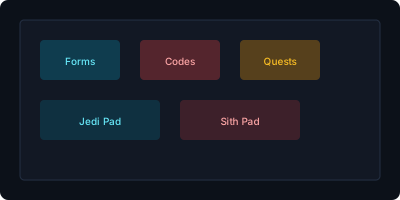
Use the lobby and map flow intelligently. The location diagram above is a reminder that movement routes shape outcomes before attacks even begin.
If you frequently feel “suddenly overwhelmed,” review your position two seconds before the collapse. Most losses begin with poor location choices rather than pure reaction speed failures.
Probe Before You Commit
Probing is controlled information gathering. Instead of forcing hard entries, use short pressure tests:
- Light timing checks.
- Baited movement triggers.
- Limited-risk interaction windows.
Your goal is to detect patterns: panic responses, delayed counters, defensive habits, and timing gaps. Once pattern confidence is high, conversion becomes safer and more efficient.
This matters against both Jedi and Sith tendencies. The names and aesthetics differ, but pattern reading logic stays the same.
Conversion Without Overcommitment
Good conversion means turning a read into advantage while preserving your exit options. To convert cleanly:
- Commit only when opponent state is unstable.
- Keep one mental step reserved for disengage timing.
- Stop chaining when probability drops.
Players lose many winnable sessions by treating one successful opening as permission for endless pressure. Smart conversion captures value, then resets.
Defensive Reset Is Part of Playing Well
Defense is not a separate mode. It is embedded in high-level play. After mistakes:
- Stabilize your movement.
- Re-establish spacing.
- Avoid immediate revenge entries.
These resets are especially important if your vulnerability bar is rising. For full detail, apply the dedicated method in How to Protect.
Session Structure Improves Match Quality
Performance drops when sessions are unstructured. Use intentional blocks:
Warm-up block
- Recalibrate timing and movement.
- Set one tactical goal.
Main block
- Apply full match loop with discipline.
- Track one metric, such as successful resets.
Review block
- Identify one repeat mistake.
- Define correction for next session.
This structure keeps quality high and prevents chaotic declines.
Reads and Adaptation in Live Matches
Adaptation is a cycle:
- Observe early responses.
- Identify reliable pattern.
- Test counter.
- Reconfirm or adjust.
Do not overreact to single events. Look for repeated behavior under similar pressure. That is where true reads come from.
If adaptation feels slow, simplify your focus to one variable at a time, such as entry timing or defensive retreat pattern.
How Resource and Gameplay Connect
Playing well requires support systems. If you are under-resourced, decision quality often drops because every loss feels expensive. Use How to Get to maintain stable Credits flow, then return to this page for execution quality.
Also check Active Codes regularly. Timely rewards can remove unnecessary pressure and let you train with better consistency.
Common Gameplay Traps
Avoid these frequent traps:
- Chasing every opponent regardless of context.
- Ignoring your own pacing after a strong streak.
- Entering from weak position because of impatience.
- Refusing to disengage when momentum flips.
- Treating losses as mechanics-only problems.
Most of these are decision errors, not skill ceiling limits.
Practical Improvement Drill
Use this drill for three sessions:
- Enter only after a probe.
- Convert only after a confirmed reaction pattern.
- Reset after each major exchange.
Track results:
- Did survivability improve?
- Did decision confidence increase?
- Did session tilt decrease?
This drill builds control habits that scale into advanced play.
June 2026 Gameplay Notes
In June 2026 testing, the best results came from players who emphasized:
- Position-first entries.
- Probe-based conversions.
- Deliberate defensive resets.
Players who relied on constant aggression had higher short burst success but weaker long-session outcomes. Consistency wins over spectacle in real progression.
Where to Go Next
After implementing this guide:
- Improve defensive resilience at How to Protect.
- Improve opportunity selection at How to Find.
- Improve objective efficiency at How to Complete.
Treat these as extensions of gameplay, not separate topics. Strong play is the combination of decision quality, survivability, and planning.
Final Playing Rule
Play with intent, not impulse. If you control tempo, choose your positions carefully, probe before committing, and reset before overextending, your Saber Unbound results will become more stable and more repeatable. That is the foundation of true improvement.